The Pathfinder Family Court Pilot: Reforming Private Law Children Proceedings
What is the Pathfinder Pilot Scheme?
Following the Assessing risk of harm to children and parents in private law children cases Report (the Harm Report) in 2020, the Ministry of Justice introduced a pilot to approach private law proceedings in an alternative way.
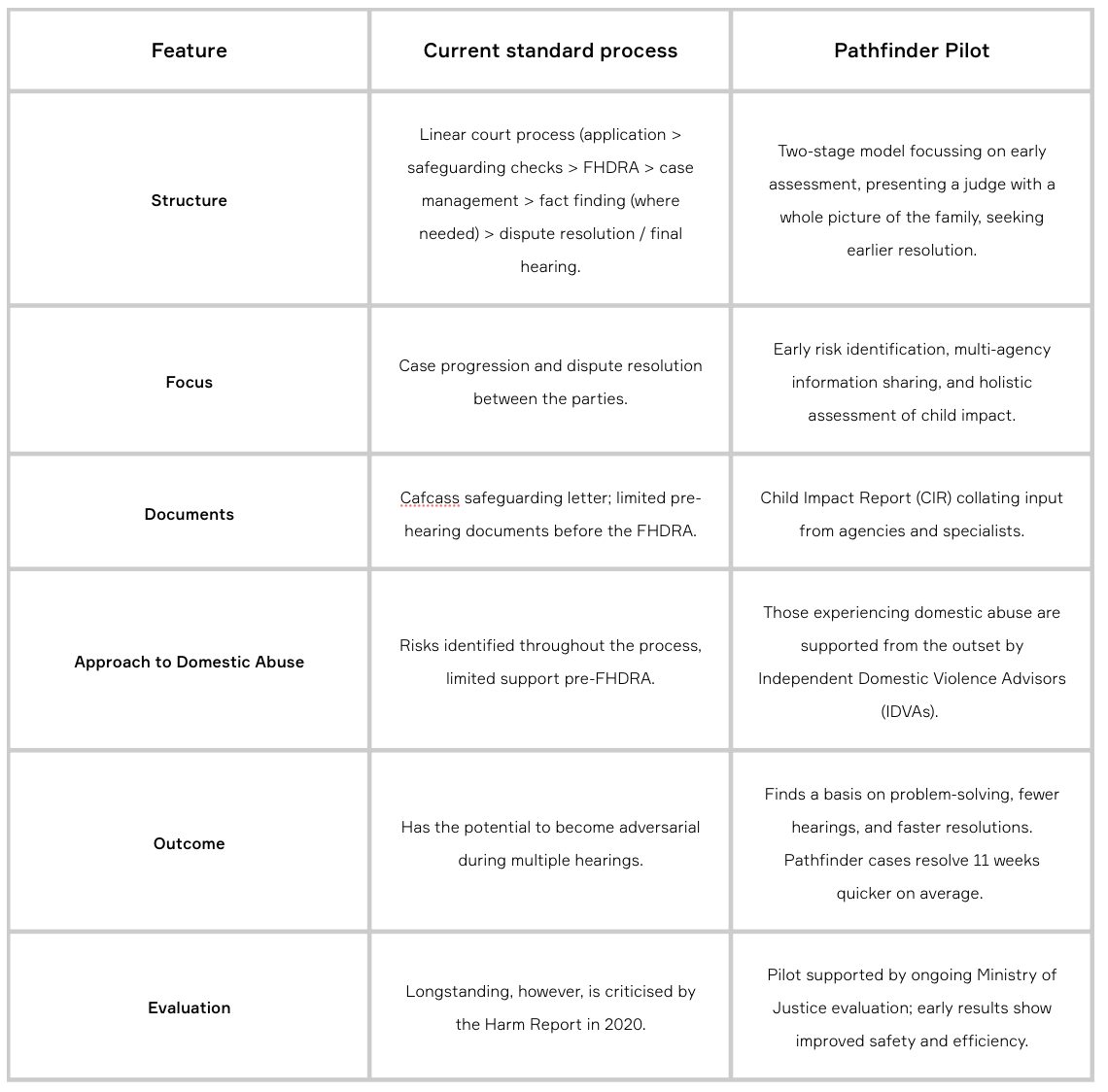
The Pathfinder pilot represents a reform in the conduct of private law children cases, shifting the emphasis from litigation to early risk assessment, safety, and holistic problem-solving. This pilot seeks to replace the standard Child Arrangements Programme in participating courts. Pathfinder seeks to make proceedings less adversarial, more supportive, and come to an conclusion more quickly.
Key aims and features of the Pathfinder model
Pathfinder seeks to do this by:
Assessing risk and family needs earlier;
Encouraging multi-agency working between the court, CAFCASS, Local Authorities and the police;
Reducing the number of hearings and delays;
Improving safety and the court experience of those who experience domestic abuse;
Producing longer lasting, sustainable orders to reduce the need to come back to court.
Where is the Pathfinder Pilot operating?
Pathfinder currently operates across North Wales, Dorset, Birmingham, and is expanding across West Yorkshire, Wolverhampton, Worcester, Stoke-on-Trent, Hampshire, and the Isle of Wight throughout 2025-26.
How does the Pathfinder Pilot work?
Pathfinder replaces the usual court process with two main stages introduced under the Family Procedure Rules Practice Direction 36ZE – Pilot Provision: Temporary Modification of Practice Direction 5B, 12A, and 12B.
Stage 1 – Information gathering and child impact report (CIR)
Here, information is gathered about the family, any risks that present, and any welfare issues. A Child Impact Report (CIR) is then prepared by CAFCASS. The CIR draws together all the relevant information for the case, including, where appropriate a risk assessment from a domestic abuse specialist (IDVA). The goal of this is to provide the judge with a full picture ahead of any hearings taking place.
Stage 2 – Interventions and/or Decision Hearing
The judge will then review the CIR and decide on next steps. This can include referring parents to mediation or non-mediative interventions, ordering further assessments, making an interim order, or holding a decision hearing to make an order.
Unlike the ordinary mode of proceedings, there is no First Hearing Dispute Resolution Appointment (FHDRA). The pilot aims for cases to move more fluidly from assessment to resolution, with an emphasis on problem-solving for families.
What does the Pathfinder Pilot mean for practitioners?
How will judges approach this?
In Pathfinder cases, judges adopt a problem-solving role. They focus on understanding the family needs earlier owing to the production of a Child Impact Report (CIR). Judges are expected to:
Engage with the multi-agency information available before deciding next steps;
Ensure proceedings have a trauma-informed approach;
Continue to consider if a case would be suitable for a non-court resolution.
What can I expect at the first hearing?
Instead of attending a FHDRA, there will be early contact from Cafcass to gather background information on the family for the CIR. The first court hearing will be an ‘Information and Decision hearing’ where:
The judge will review the CIR;
Risks and welfare issues will be discussed;
The judge decides whether the case can be resolved through non-court means or needs further judicial intervention.
Conclusion: Early lessons from the Pathfinder Pilot
In March 2025, the UK government published a report to update on the implementation of the government’s Pathfinder programme for private law reform. Notably, the government highlight the lessons learned from early Pathfinder pilots in North Wales and Dorset have assisted in refining the process during roll-out to other areas of the UK.(1)
In late-2025, the government intend to publish the feasibility study to explore the potential approaches to evaluate the Pathfinder pilot. Following this, an impact evaluation will be undertaken to provide data showing the real-world impact of Pathfinder on private law proceedings in England and Wales.
(1) An update on the implementation of the Government’s Pathfinder programme for private law reform, para. 4.3, p.11.
Law is correct as of 27th October 2025. Whilst every effort has been taken to ensure that the law in this article is correct, it is intended to give a general overview of the law for educational purposes. Readers are respectfully reminded that it is not intended to be a substitute for specific legal advice and should not be relied upon for this purpose. No liability is accepted for any error or omission contained herein.